Im Pregnant and Always Hungry and I Sometimes Eat Late Will It Affect the Baby
Abstruse
Which snack would you prefer? A bag of chips or carrot sticks? Water ice foam or an apple tree? About of us would probably choose the junk food. While sometimes it is OK to have chips or water ice cream, if y'all eat junk food all the time it is pretty obvious you will begin to gain weight. What might not exist obvious is that a poor diet can also modify your brain! Fifty-fifty earlier a babe is born, what the parents eat tin affect how the baby'south brain develops. Hither, we tested what happens to the brain if nosotros begin to eat healthier equally we grow, after eating poorly early in life. We found that eating poorly when the brain is developing changes our decisions about nutrient. All the same, we can fix some of this impairment with a skillful nutrition. Excellent news for kids and adults who accept health problems from eating a poor diet early in life.
A Baby's Diet Can Change How information technology Thinks About Nutrient
Scientists now know our nutrition in early life is really important for our wellness in the long-term. If your dad was obese when yous were conceived, or if your mom ate too much junk food when she was pregnant with you lot, or if you started eating chips and drinking cola earlier you could walk, these bad eating habits can play havoc with your encephalon and the fashion you think almost food. Nosotros were interested to see if the negative effects of eating poorly in early life could be reversed past eating a healthier diet as we get older.
How Practice We Know When We are Hungry?
As both children and adults, nosotros take brains that are commonly very good at telling the states when we are hungry and when we are full. Y'all may discover that, merely before dinner time, you commencement feeling hungry, even if you are decorated playing an interesting game. But yous do not normally experience hungry all day. This is because we have a hormone chosen " ghrelin " that increases in the blood just before meal times or when nosotros have not eaten for a while.
Ghrelin comes from the stomach and travels in the blood. Ghrelin ends upwards in the brain and tells the brain to feel hungry and commencement eating. Just like the players on a football team, all of the different parts of the brain accept different jobs to do. They go along communicating with each other to aid each other out, just they still accept adequately split functions. The part of the brain that ghrelin talks with to tell our bodies that we are hungry is called the hypothalamus . The hypothalamus is really important. Different parts of the hypothalamus control how stressed we experience, whether nosotros are able to have babies when we grow up, how thirsty we are, how we grow, and also…how hungry nosotros feel [1].
Another important hormone that tells kids and adults how hungry they feel is leptin . Leptin comes out of the fat in the torso and tells u.s. to stop feeling hungry. Leptin is normally present all the fourth dimension and, similar a cherry traffic low-cal, it stops us from being badly hungry throughout the whole day. But, if we get and so starving that our fat levels decrease, no more leptin is fabricated, and we kickoff feeling really hungry once more. Together, ghrelin and leptin talk to the hypothalamus to make certain that we consume enough to keep our energy levels high and our bodies salubrious.
How Does Our Hunger-Sense Develop?
Back to babies, though. Babies that are however within their moms exercise not accept to eat to get their energy. They get their nutrition and energy from mom. So, when the baby is developing, ghrelin and leptin do a different job. They help the baby'due south encephalon to develop. Ghrelin and leptin are specially of import in unborn babies for making neurons grow between different parts of the hypothalamus [ii, 3].
Neurons are tiny cells in the brain and they control how different parts of the brain talk to each other and how we become information from our eyes, and ears, and stomachs, to the brain. Nigh neurons wait a bit like wires with a blob on one end (see Figure i for a motion-picture show of some existent neurons and some diagrams of what neurons look like). Information is received at the blob end, travels down the wire (axon), splits, and is delivered to the other neurons at afar parts of the brain.
Fun fact : Most neuron wires (axons) are so sparse that 1,000 of them tin fit in i mm. The squid has a behemothic neuron that is and so large we can see it without a microscope. Its axon can be 1 mm wide, the size of a small-scale pencil lead!
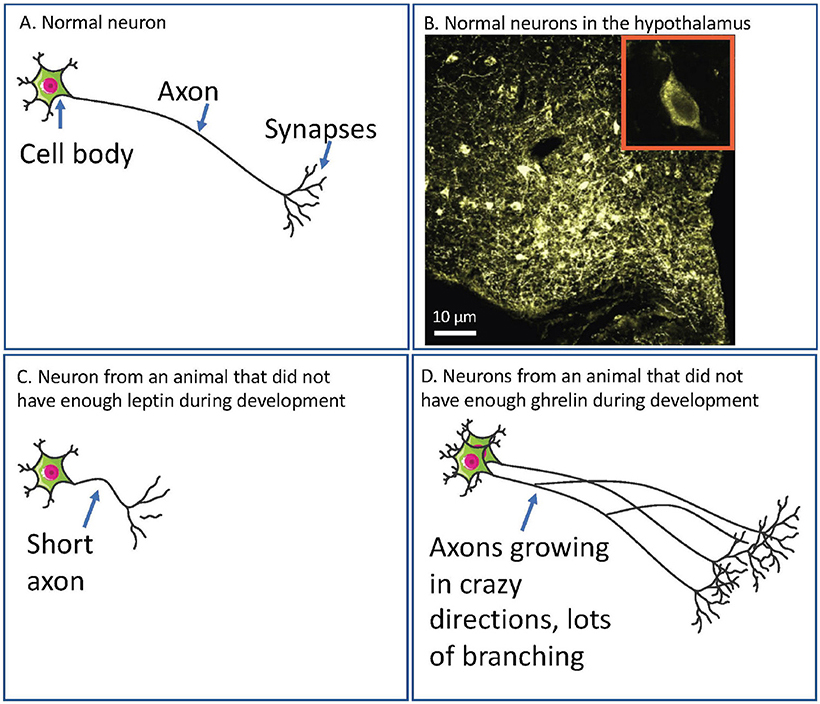
- Figure ane - (A) A diagram of a normal neuron.
- The cell body receives data from the external world (such as from lite if it is a neuron in your centre) or from other neurons. The axon carries the information from the prison cell body to the synapses. It is then passed on to other neurons or to organs of the torso, like the tum, at the synapses. (B) A microscope image of neurons in the hypothalamus of a rat. The large image shows lots of jail cell bodies in xanthous (the roundish blobs). The speckly coloring is the axons. Each jail cell body is near 10 µm in diameter (one mm divided into 100 pieces). The pocket-size inset shows a zoomed in view of one cell body. The darker oval in the eye is the nucleus, which contains all the information the neuron uses to communicate. (C) If neurons in the hypothalamus do non have enough leptin, and so their axons exercise not grow properly. This ways these axons cannot properly carry information almost how total or hungry the body is. (D) If neurons in the hypothalamus exercise not have enough ghrelin, then they practise not stop growing when they should. This ways these axons might carry so many signals that the message is confused and the brain still cannot communicate effectively about how full or hungry the torso is.
In babies that have non been born even so, the neurons that ship data about food and hunger (let us call these "feeding neurons") accept not got the really long axons yet, and then they cannot talk very well to other $.25 of the brain. Leptin helps these axons grow. Ghrelin stops them from growing likewise much. If babies do non have enough leptin at this time, these feeding neurons cannot grow and then can never carry information near how hungry or full the body feels. If there is not enough ghrelin, these feeding neurons abound too much (see Figure 1 for how this might look in the encephalon). In both cases, the babe can grow upward unable to tell properly if it is hungry or total. The usual effect of this for the kid growing up is that he or she eats too much.
What Mom Eats Can Change How the Infant'south Brain Develops
Scientists now know that what mom eats during pregnancy, and whether she is obese, may change the amount of leptin and ghrelin in the baby. The levels of leptin and ghrelin may change the fashion the baby's feeding neurons grow and how the baby senses hunger when it grows up. Scientists in the past accept suggested that this effect is permanent. They plant that once babies are past the right time for the hypothalamus to develop there is nothing that can exist done to get these feeding neurons to grow properly [4]. BUT…these experiments were done in animals that could not make leptin at all. We were interested to know if these changes to the way the neurons grow could really exist reversed in normal individuals, past a balanced diet starting afterward the baby is born.
Using Rats and Mice to Figure Out What is Going On in the Man Brain
For about scientific studies, it is pretty hard to await inside a human brain to find out what is going on. So, we use what are called animal models, normally rats and mice. Rats may seem very different from humans, but they are actually quite similar. Rats see and aroma and walk and sleep, they get tired and scared. They also get hungry, consume, and feel total. The way rats know they are hungry is because of ghrelin and leptin talking to the same part of the brain every bit they practice in humans, the hypothalamus.
In that location is one key deviation between humans and rats, though. In humans, the feeding neurons kickoff growing before the baby is born. In rats, these feeding neurons get-go growing after nascence. In our laboratory, we can apply this key difference to test how diet affects ghrelin, leptin, and feeding neuron growth without affecting the mom's pregnancy or any other factors.
In our experiment, nosotros took two groups of female parent rats that had just given birth and we changed the number of babies each mother had to feed. Rat mothers commonly give birth to around 12 babies (ask your mom how she would like to have 12 kids all at in one case!). So, feeding 12 babies is normal for a rat mother. Because it is the normal state, having 12 babies to feed is called a control group. We compared babies fed in lots of 12 (our command grouping) with babies fed in lots of just four. When there are only four rat babies, they do not take to fight for their food, then they become to eat ALL the fourth dimension. Because of this they get very fatty. After three weeks of constant eating, the babies fed in lots of four weighed nearly one-third more than the command group babies. That is one big rat!
What Happens to Leptin and Ghrelin When Babies Eat Also Much?
Because these fatty rats drank so much more milk and had then much more than fat, they had heaps of leptin. 14 times as much leptin compared with rats in the control group! Imagine if you usually demand merely one cup of milk per day to keep salubrious. The amount of milk the rats in our experiment drank would be similar y'all having nearly 2 L of milk instead! These fat rats likewise had much less ghrelin—probably because their bodies were trying to tell them they were not hungry.
What Happens to the Hypothalamus When Babies Eat Besides Much?
Probably because of all this extra leptin, these fat rats had much more feeding neuron growth in the hypothalamus. Even though there were more than feeding neurons in the hypothalamus, these feeding neurons did not work as hard. If we gave the fat rats leptin, the leptin failed to talk to the feeding neurons, significant that the leptin was less able to tell the brain "enough food, end eating," so the rat would eat more. Information technology is not surprising, then, that these fat rats cannot properly tell when they are hungry or full, and that they stay fatty every bit they grow up. Or is it…?
Poor Diet in Babies Tin can Damage the Hypothalamus, Just this Can Recover every bit they Grow Up
When the rats were done feeding from their mothers' milk and it was time for them to eat solid nutrient, we gave all the rats, the fat ones and the sparse ones, a good for you rat nutrient. This food is a wee bit boring…information technology looks a bit like paper-thin, and we are sure they would prefer a burger now then, but it is very salubrious for the rats and contains all the ingredients they need.
Afterwards these rats had all been fed this salubrious diet for a actually long fourth dimension—until they were grown up, we looked at their brains. Here, we found something really exciting. The feeding neurons had get normal! The feeding neurons were the same in the hypothalamus of the fatty rats as they were in the control grouping! The grown-up fatty rats were also able to respond to leptin in the aforementioned mode that the thin, control rats did. The other really interesting matter we institute is that the hypothalamus of female rats comes back to normal much more easily than the hypothalamus of male rats [5]. We exercise non know why this is, even so.
It is still non 100% proficient news for rats that had a poor diet when their brains were notwithstanding developing. We also saw that the fat rats were sicker when they got an infection. The fatty rats were also not as good at some retentiveness tests. And, they stay fat even on the healthy diet. But the skillful news is that, even though poor diet during evolution tin mess up the fashion feeding neurons abound in the hypothalamus, the brain can recover from this! Our findings are heady and encouraging for kids and adults who have health bug due to eating a poor diet in the past. Our work suggests that switching to a healthy diet tin reverse some of the encephalon damage caused by a poor diet.
Glossary
Hormone ("Hor-Moan"): ↑ A substance coming from one of the organs in the body that travels to another organ and tells it what to practice.
Ghrelin ("Gre-Lin"): ↑ A hormone that tells the brain to eat more.
Hypothalamus ("Hie-Po-Thal-A-Mus"): ↑ A brain region that is responsible for controlling feeding (and another important things).
Leptin ("Lep-Tin"): ↑ A hormone that tells the brain to stop eating.
Neuron ("New-Ron"): ↑ A jail cell in the brain that receives information from the torso or other neurons and passes the information on. Lots of neurons together control how we respond to the information and what nosotros think or feel about it.
Conflict of Interest Statement
The authors declare that the research was conducted in the absence of whatsoever commercial or financial relationships that could be construed equally a potential conflict of interest.
Original Source Article
↑ Sominsky, L., Ziko, I., Nguyen, T. Ten., Quach, J., and Spencer, S. J. 2017. Hypothalamic effects of neonatal diet: Reversible and only partially leptin dependent. J. Endocrinol. 234:41–56. doi: x.1530/JOE-16-0631
References
[1] ↑ Saper, C. B., Lowell, B. B. 2014. The hypothalamus. Curr. Biol. 24:R1111-vi. doi: 10.1016/j.cub.2014.10.023
[ii] ↑ Steculorum, S. Grand., Collden, G., Coupe, B., Croizier, Southward., Lockie, Southward., Andrews, Z. B., et al. 2015. Neonatal ghrelin programs evolution of hypothalamic feeding circuits. J. Clin. Invest. 125:846–58. doi: x.1172/JCI73688
[3] ↑ Bouret, S. G., Draper, South. J., Simerly, R. B. 2004. Germination of project pathways from the arcuate nucleus of the hypothalamus to hypothalamic regions implicated in the neural control of feeding behavior in mice. J. Neurosci. 24:2797–805. doi: x.1523/JNEUROSCI.5369-03.2004
[iv] ↑ Bouret, Southward. G., Draper, S. J., Simerly, R. B. 2004. Trophic activity of leptin on hypothalamic neurons that regulate feeding. Science 304:108–10. doi: ten.1126/science.1095004
[5] ↑ Ziko, I., Sominsky, L., Nguyen, T.-X., Yam, K.-Y., De Luca, South., Korosi, A., et al. 2017. Hyperleptinemia in neonatally overfed female rats does non dysregulate feeding circuitry. Front. Endocrinol. 8:287. doi: 10.3389/fendo.2017.00287
jorgensenbeill1957.blogspot.com
Source: https://www.frontiersin.org/articles/401700
0 Response to "Im Pregnant and Always Hungry and I Sometimes Eat Late Will It Affect the Baby"
Post a Comment